
Enclosed Eaves: Closing the Gap Beneath the Roof Edge
Eaves extend beyond a home's exterior wall. Open eaves expose rafter tails and gaps under the roof edge; enclosing them with a soffit covers that underside. The aim is to reduce places where embers may lodge or enter while coordinating ventilation and roof details.
WildfireList calls this measure Enclosed eaves, as shown on its Safer from Wildfires list. It works alongside suitable vents, roof maintenance, and clearance of nearby combustible material. It cannot assure an outcome in a wildfire.
What Enclosed Eaves Mean in California
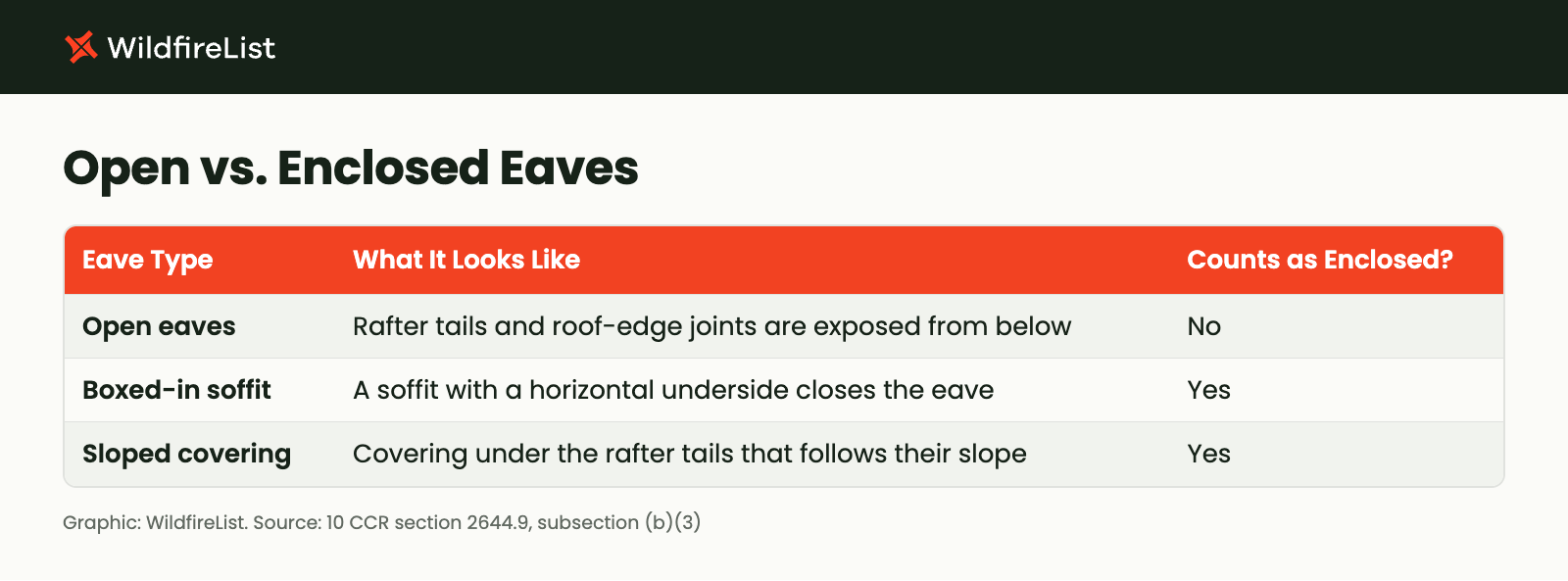
10 CCR section 2644.9, subsection (b)(3), defines enclosed eaves as either boxed-in soffits with a horizontal underside or covering under the rafter tails that follows their slope. Open eaves have exposed rafter tails. Subsection (d)(1)(B)(2)(b) lists enclosed eaves as a property-level hardening measure. Ask the local building department what code edition and requirements apply to a specific project.
The Wildfire Prepared Home Plus Technical Standard calls for noncombustible eave and soffit material, giving fiber cement, stucco, and metal as examples. That is a program standard, not a claim that 10 CCR section 2644.9 mandates those materials for every retrofit.
Why the Roof Edge Matters
Open eaves expose rafters and roof-edge joints, where embers may lodge or enter. Nearby flames and radiant heat can also expose the edge. Enclosure changes that geometry, but gaps, combustible materials, and poorly coordinated vents can remain. Inspect the whole roof edge, not just the soffit panel.
Syphard and Keeley's California study analyzed inspection records for more than 40,000 structures exposed to wildfire from 2013 through 2018. Enclosed eaves, vent screens, and multi-pane windows were among the structural characteristics most consistently associated with survival. The analysis was observational, not a test of one retrofit, and individual variables had limited explanatory value. See the study for its methods and limitations.
FEMA's 2025 Maui report records open and closed soffits and discusses soffit construction and ember-resistant vents. It is a field report from one event, not a California code interpretation.
What the Work Involves
Survey, Materials, and Details
Inspect the roof perimeter for open sections, fascia and rafter-tail condition, existing vents, lights, wiring, and other penetrations. A written scope should name material, fasteners, finish, corners, and roof-to-wall transitions; document mixed rooflines and dormers separately.
Soffit panels or other covering close the underside. The Wildfire Prepared Home Plus standard names noncombustible fiber cement, stucco, and metal. Coordinate the assembly with local code and the manufacturer's instructions. Do not cover a vent or unknown opening; ask how required airflow and any remaining vent's ember resistance will be maintained.
Work may remove old trim, repair the substrate, install panels, close seams, and finish the surface. The cited standards set no universal duration. Schedule depends on roof geometry, height, access, damage, and finish work. Request a written site-specific schedule, including permit review and weather contingency.
Questions to Ask Before Hiring
Ask: Which eave sections are open, and are all roof edges included? What material will close each section, and why is it appropriate for this site? How will the installer preserve required ventilation and handle any existing soffit vents? Will fascia, rafter tails, gaps, and roof-to-wall transitions be repaired or left as-is? Does the work require a permit or inspection locally? What photos and itemized invoice will document the finished assembly? Ask the contractor to identify exclusions in writing, especially decorative eaves that look closed but have gaps behind trim.
Where WildfireList Fits
WildfireList is a directory of California wildfire mitigation providers and suppliers. The Enclosed eaves page is where to find providers who offer this work. Compare written scopes, licenses and references before you hire, and ask your local building department which code requirements apply to your property.
Next Steps
Find pros for enclosed eaves on WildfireList.
Sources
Your mitigation work may qualify you for wildfire discounts on your premium, but they aren't applied automatically. See How to Get Your Discounts