
Certified Wildfire Mitigation Specialists: A Whole-Property View of Wildfire Mitigation
A wildfire mitigation plan can involve work on a roof, around the house, and across a neighborhood. A Certified Wildfire Mitigation Specialist (CWMS) can help a homeowner understand how site conditions and possible work fit together. The National Fire Protection Association (NFPA) administers the credential. It is an individual knowledge certification, not a property designation or construction project.
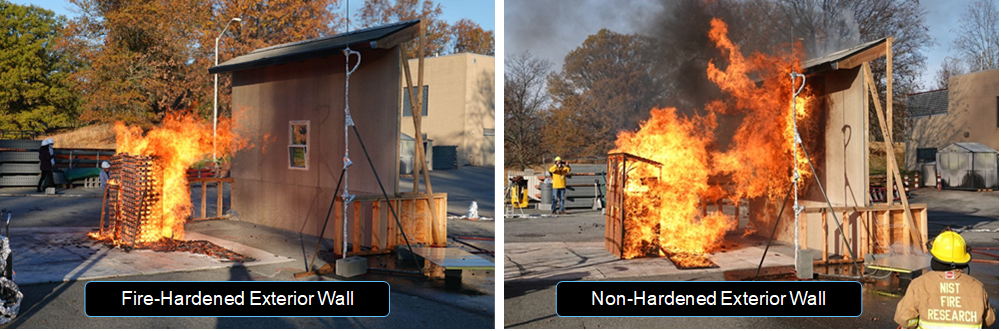
The NIST image documents a structure exposure experiment involving a burning shed. It illustrates why an assessment can look beyond one building feature; it is not a CWMS field assessment. Image: NIST, “Exterior Walls Hardened versus Non-Hardened,” asset page. NIST says its site material not marked as copyrighted may be copied or distributed with an appropriate image credit. See NIST use and copyright information.
What the NFPA CWMS Credential Represents
NFPA describes CWMS as evidence of knowledge in wildfire hazard mitigation, planning and preparedness, public education, and wildland fire science. Its exam is a three-hour, closed-book test with 100 multiple-choice questions. Candidates also complete a practicum that includes wildfire risk assessments on four residential structures. NFPA identifies the credential for people responsible for mitigation, planning, preparedness, education, and related fire-science concepts; its examples include arborists, wildfire mitigation consultants, and mitigation specialists. See the NFPA CWMS program page.
CWMS belongs to an individual, not a company as a whole. NFPA maintains the program and its public verification portal. Ask for the person's full credential name and confirm current status directly with NFPA. A directory entry or old screenshot is not the authority on current status. The credential indicates knowledge assessed through NFPA's program; it does not mean NFPA inspected a particular property or endorses a contractor.
California law and the credential address different things. For structures in the State Responsibility Area, Public Resources Code section 4291 addresses defensible-space duties and says fuel management should consider building materials, location, and vegetation. It is not a CWMS definition. Ask the local fire authority about applicable rules and inspections.
What a Specialist May Assess
NFPA requires residential structure assessments in the CWMS practicum, but does not prescribe one consumer report or one scope for every engagement. Set the boundaries and deliverables in writing. Depending on the scope, an exterior walk-through may review roof and gutter conditions, vents and open eaves, windows and siding, decks, combustible materials near the structure, outbuildings, and vegetation. Ask whether the visit is exterior-only, whether an attic or other space is included, and what cannot be assessed.
Ask whether the deliverable includes dated photographs, a site sketch or map, observed conditions, recommendations grouped by location, and items needing confirmation by a contractor or local authority. These are details to settle in the written scope, not promises made by the credential. NFPA does not set a universal appointment length or report turnaround for private assessments. Ask how much time to reserve and when written recommendations will arrive.
Why the Measures Work Together
A roof, vent, eave, window, wall, deck, vegetation, and nearby outbuilding are different parts of one property. A specialist can help a homeowner consider their placement and condition together, rather than as isolated checklist items. For example, the homeowner can ask how nearby combustible material relates to the house, or how an opening and roof edge fit into the home's overall exposure. Recommendations should be tied to what the assessor observed, not assumed from a generic list.
Research supports looking at more than one scale. NIST's WUI Structure/Parcel/Community Fire Hazard Mitigation Methodology considers structures, parcels, and communities together. A USDA Forest Service summary of parcel-level assessment research describes differences among properties and reports that risk factors can cross property boundaries. That research supports parcel-level review; it did not test CWMS or guarantee that a recommendation changes an outcome. See NIST Technical Note 2205 and the Forest Service's parcel-level assessment summary.
The assessment itself is advisory work: a site review, discussion of observations, and agreed recommendations. It does not install vents, replace roofing, prune trees, remove a shed, or complete community recognition. If a report recommends construction or land work, ask who will perform it, what the contract includes, and whether permits or a separately licensed trade are needed. Because a CWMS visit is not a prescribed retrofit package, NFPA does not publish one standard duration or material list for it.
Questions to Ask Before Hiring
- What is your current NFPA CWMS status, and under what name can I check it?
- Which parts of the property are included? What is outside the scope?
- Will I receive a written report, dated photos, and recommendations tied to observed conditions?
- Do you only assess, or do you also sell or perform recommended work?
- How long should I reserve for the visit, when will the report arrive, and what is the fee?
- Which observations need confirmation by a local fire authority, building official, or contractor?
Firewise USA Adds a Community Layer
A property assessment concerns one site. NFPA's voluntary Firewise USA program helps neighbors organize around community wildfire risk, make an action plan, and report annual work. NFPA describes a community-wide risk assessment, updated at least every five years, and a three-year action plan. Firewise recognition belongs to a participating community, not to an individual home or contractor. It can address shared priorities that a single-property visit cannot coordinate by itself.
Where WildfireList Fits
WildfireList gives CWMS specialists a separate advisory category alongside the mitigation work categories. Specialists assess the whole property and help a homeowner understand how measures may relate; separate providers perform the work. A CWMS listing is not an NFPA credential or quality rating, and WildfireList does not issue the certification. Confirm current status with NFPA.
Call to Action
Browse WildfireList's CWMS specialist listings, then confirm the individual's current status directly with NFPA. The specialist category is advisory; the work itself is performed separately.
Sources
- NFPA, Certified Wildfire Mitigation Specialist.
- NFPA, Certification verification portal.
- NFPA, How to Become a Firewise USA Site.
- California Public Resources Code, section 4291.
- NIST, WUI Structure/Parcel/Community Fire Hazard Mitigation Methodology, Technical Note 2205.
- USDA Forest Service, Watts et al., “Sometimes Simple Works: The Value of Rapid Parcel-Level Wildfire Risk Assessments”.
- WildfireList, CWMS specialist listings.
Your mitigation work may qualify you for wildfire discounts on your premium, but they aren't applied automatically. See How to Get Your Discounts